Unicorn Platform: How to Launch a Professional Website Before You Ever Touch a Line of Code
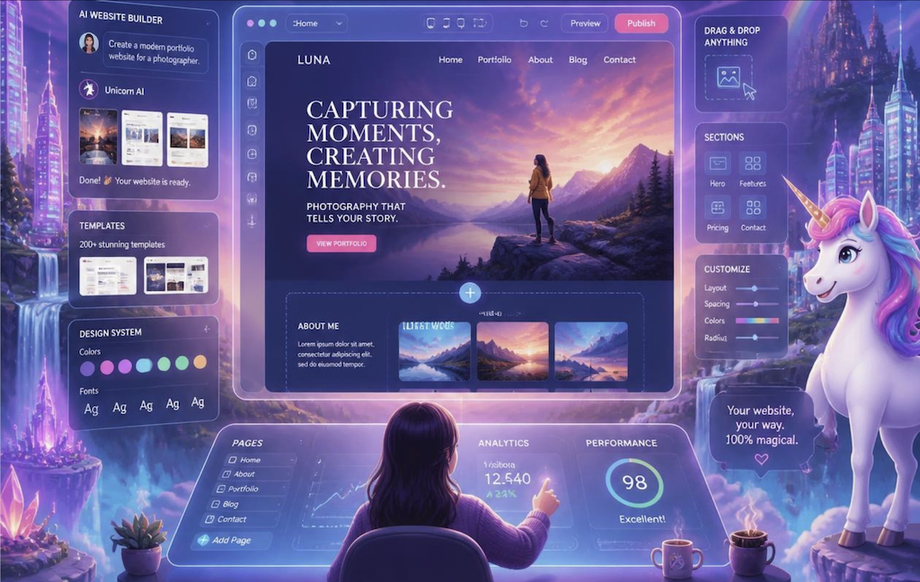
Building a website used to mean one of two things: hire a developer and wait weeks for a result, or spend your own evenings wrestling with a page builder that never quite matched the vision in your head. For founders trying to launch a SaaS product, an app, or a directory, that delay is not a small inconvenience — it is time your competitors are spending getting discovered.
Today, that trade-off is disappearing. An AI-powered website builder gives you a working, polished site in the time it used to take just to pick a template, and it is changing how early-stage teams think about launch timelines.
Why Website Building Has Always Been Slower Than It Should Be
The core problem was never a lack of tools — it was a lack of judgment built into those tools. Most builders hand you a blank canvas and assume you already know what good design, clear copy, and a working contact form look like. For a founder who is not a designer or a developer, that assumption creates friction at every step: which block goes where, how to phrase a headline, how to fix a typo buried in twelve nested elements, how to get a CTA to actually convert.
None of this is exotic knowledge. But it takes time to learn, and time is exactly what an early-stage team does not have.
What Unicorn Platform Actually Does
Unicorn Platform is an AI website builder built specifically for people who need a site fast and do not have design or development skills to fall back on. It is aimed squarely at SaaS products, apps, directories, blogs, and personal pages — the categories of site that founders and solo builders create most often.
The newer AI version of the platform pushes this further. Instead of manually rearranging blocks, users can ask the AI to edit a section directly, insert custom HTML where the built-in blocks are not enough, and generate content on the spot. Fixing a grammar error, writing a contact form, or adding a call-to-action no longer requires opening a separate tool or hiring outside help — it happens inside the same editing flow.
The Features That Actually Save Time
- AI-powered block editing. Instead of dragging and rebuilding a section from scratch, you describe the change and the AI applies it directly to the block you are working on.
- Custom HTML insertion. For anything the pre-built blocks cannot handle — an embed, a widget, a specific layout tweak — you can drop in your own code without breaking the rest of the page.
- AI content generation. Headlines, feature descriptions, and page copy can be generated and refined on the spot, which matters most for founders who are confident in their product but not necessarily in their copywriting.
- Built-in grammar and CTA assistance. Small details like a typo in your pricing page or a missing call-to-action are exactly the things that get overlooked under deadline pressure — and exactly what the AI is designed to catch.
How to Use It Before You Launch
The most effective way to approach a tool like this is to treat the AI as a first-draft partner, not a final decision-maker. Get your core pages up — homepage, pricing, contact — using the AI's block editing and content generation, then go back through and adjust the language until it sounds like you, not like a template.
Once the site itself is live, the next challenge is getting it seen. A polished site with no traffic behind it is still an unfinished launch. This is where founders often turn to resource lists like these 18 startup directories that actually help people discover your product to plan where to submit early, or a roundup of 24 free business listing sites worth checking before you scale further to get initial visibility without spending on ads. Teams moving fast on a SaaS launch often use a directory submission tool for SaaS launch teams to handle the process in bulk rather than one form at a time, and for a broader push across the web, a directory submission service for websites can take that work off your plate entirely.
The Bottom Line
A website builder will not write your business plan or find your first customers for you. But it can remove the single biggest obstacle between a good idea and a live, professional site: the time and skill it used to take to build one. Unicorn Platform is built around exactly that gap — AI handling the editing, the copy, and the small fixes, so founders can spend their limited time on the product itself rather than the page describing it.
If you are planning your next launch, start with the site before you start with the ad spend. Build it fast, get it in front of the right directories, and let the product speak for itself.